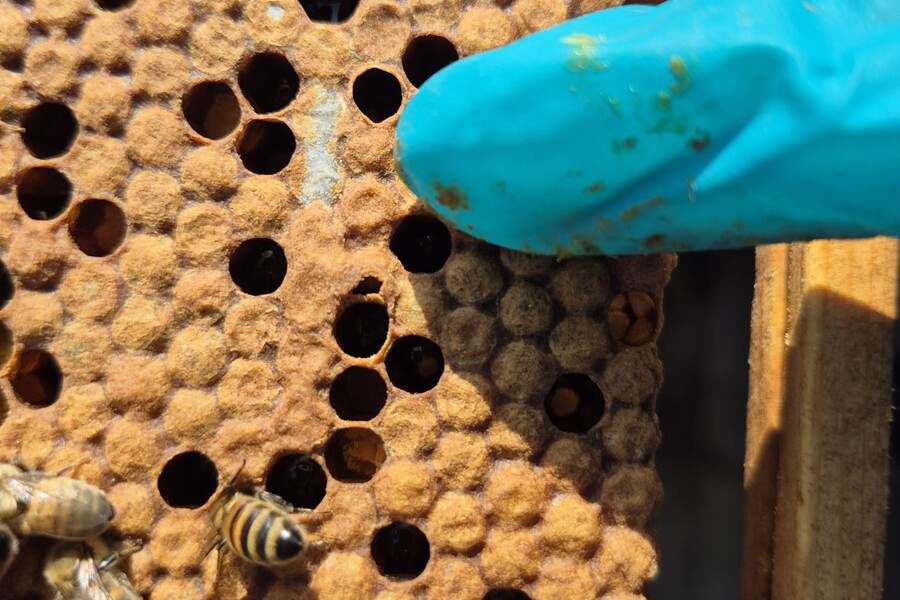
Normal appearance and development of healthy eggs, larvae, pupae and adult bees.
Practical Beekeeper Standard · Competency C9
Adult bee and brood health
Assess adult bees and brood for signs of disease, disorder or abnormal development; interpret potential causes; investigate appropriately; take measures to control and prevent spread; and obtain specialist, laboratory or statutory assistance where required.
Knowledge
Knowledge requirements
Signs associated with important brood diseases and disorders.
Signs associated with important adult-bee diseases, nutritional problems, poisoning, viruses and other disorders.
How Varroa, queen failure, starvation/chilling and other non-infectious factors may mimic or contribute to disease signs.
Principles of differential diagnosis and why visual signs alone may be insufficient for definitive diagnosis.
Routes of disease spread and immediate containment actions.
When laboratory confirmation, specialist advice or statutory notification is required.
Appropriate beekeeper-level control, treatment, destruction or equipment-management principles within legal and competence limits.
Skills
Practical skills
Systematically assess brood and adult bees for normal and abnormal signs.
Document abnormal findings accurately using records and images where appropriate.
Develop a reasoned differential assessment rather than jump to unsupported diagnosis.
Take immediate biosecurity/containment measures appropriate to the suspected risk.
Obtain or facilitate appropriate samples, confirmation or expert inspection where required.
Apply appropriate control/treatment within the beekeeper role and current rules.
Review colony response and modify management as further evidence becomes available.
What assessors need to see
Routine health assessment should be embedded throughout the portfolio, with real abnormal findings used where encountered. Rare or notifiable conditions may be assessed through high-quality scenarios and professional discussion.
Based on genuine activity
Knowledge may be evidenced through short written explanations, annotated photographs, small videos, records or professional discussion, but it should relate to an actual activity, colony, apiary, manipulation, observation or management decision the candidate has carried out or genuinely been involved in.
Evidence accumulates over time
One activity may map to several KSBs. Practical competence must be evidenced practically; scenarios support rare or uncontrollable situations but do not replace practical evidence where a genuine opportunity can reasonably occur.