
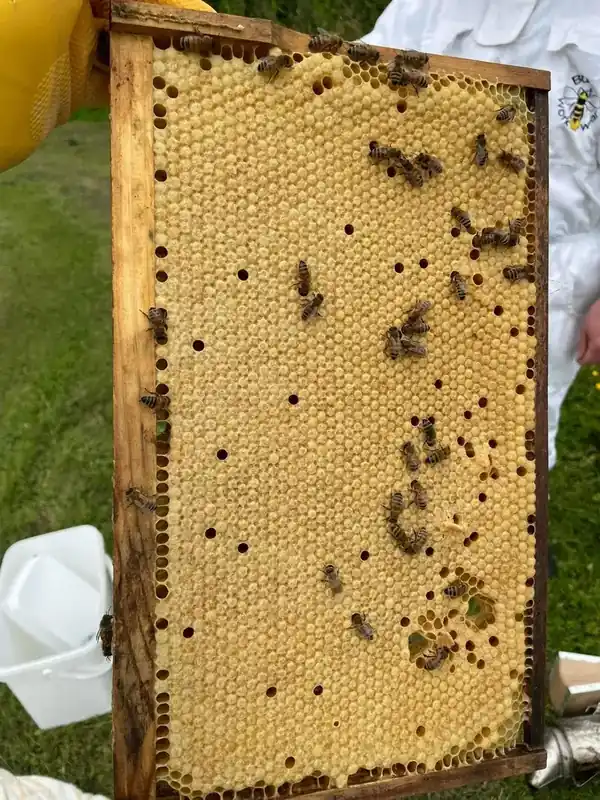
Select, maintain, clean, store and replace equipment and comb according to colony health, disease risk and management objectives.
What this competency covers
The BeeEducated Practical Beekeeper Standard uses Knowledge, Skills and Behaviours (KSBs) to describe competent practice. In this area the learner is expected to build an integrated understanding rather than memorise isolated facts.
- equipment condition
- comb renewal
- old or contaminated comb
- Bailey-type comb change
- shook-swarm-type comb replacement where justified
What competent practice looks like
Competent practice means observing accurately, interpreting what the colony is showing, choosing a proportionate response, carrying it out safely and then reviewing the outcome. A learner should increasingly be able to explain not only what they did but why they did it and what evidence would make them change course.
Naturally occurring evidence opportunities
Evidence for this area may arise during normal apiary work. Suitable opportunities can include:
- Bailey comb change
- Shook swarm
- Autumn & winter preparation
One authentic activity can contribute evidence to several competency areas. It should not be repeated simply to create paperwork when the evidence already exists.
Suitable evidence might include
- dated colony or apiary records that establish context;
- short video clips showing the learner carrying out practical work;
- photographs where they add useful evidence rather than decoration;
- a short learner explanation of observations, interpretation and decisions;
- mentor comments confirming what the learner did independently and where support was needed;
- follow-up evidence showing the result of a management decision;
- professional discussion where the assessor needs to explore reasoning, alternatives or uncertainty.
What makes evidence strong?
BeeEducated uses the VARCS principles: evidence should be Valid, Authentic, Reliable, Current and Sufficient. The learner does not need to prove everything in one session. Their portfolio develops as their beekeeping develops.
Common evidence gaps
- The task is shown, but the learner’s reasoning is not clear.
- The mentor is visibly making the key decisions rather than the learner.
- The colony context is missing, so the assessor cannot judge whether the action was appropriate.
- There is no follow-up where the outcome is important to the competence being demonstrated.
- Evidence is staged only for assessment rather than arising from appropriate beekeeping practice.
Planning your next evidence opportunity
In the BeeEducated Competency Passport, learners and mentors will be able to select an activity, see the competency areas it may support and create a Next Evidence Plan. The plan helps the learner know what to look for and what evidence may be useful without scripting the answer.